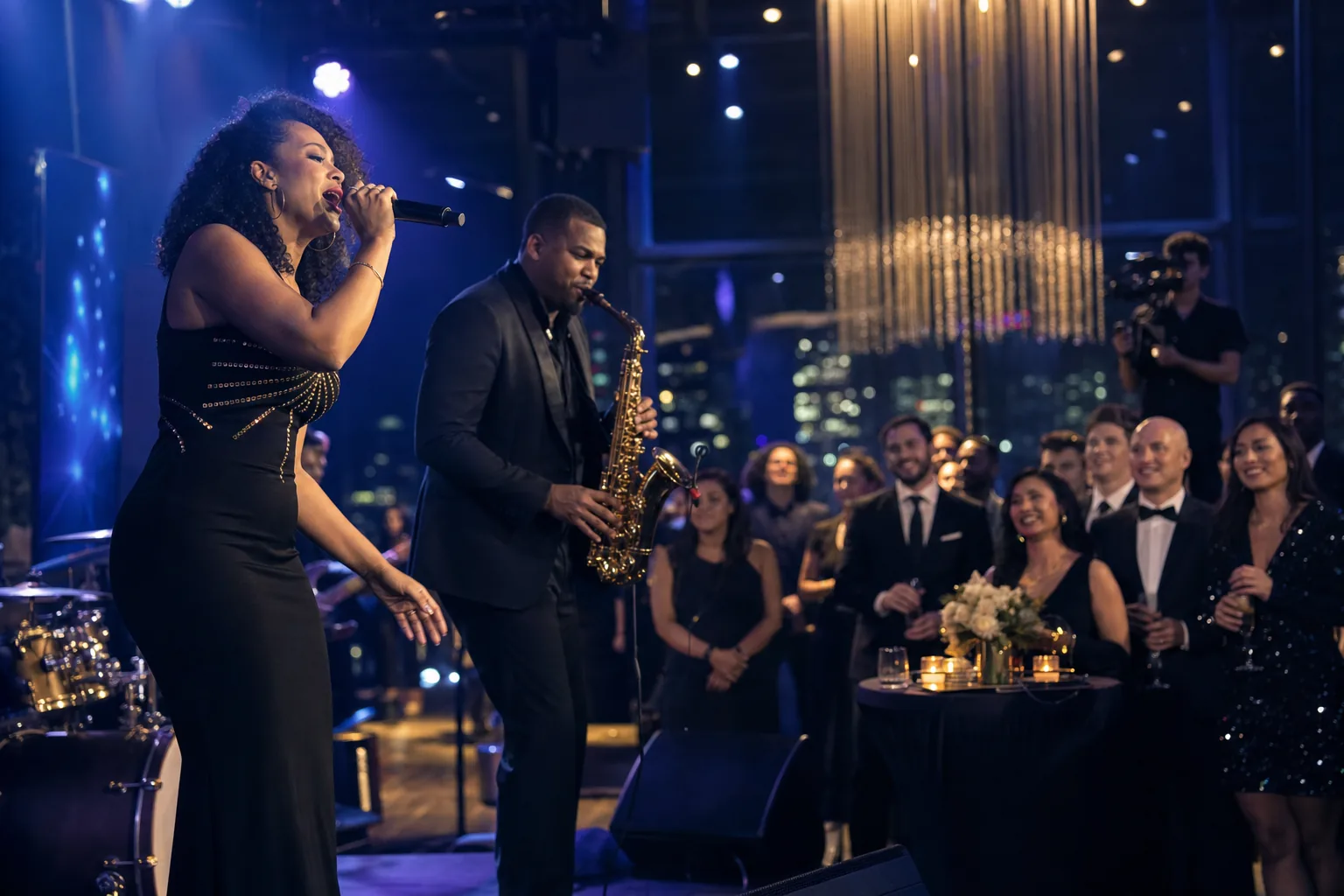
Live bands
From refined dinner sets to a high-energy dance floor, with size and musical direction considered around the event.
Music & entertainment Toronto & GTA
Find the format that fits the room. Live bands, DJs, solo musicians, ensembles and specialty performers—recommended around your audience, venue, schedule and creative direction.
Curated for the room
We focus on the role entertainment needs to play: setting a tone, supporting conversation, creating a feature moment or moving the room into celebration. From there, we shape the most suitable format for the audience, venue and schedule.
Availability, repertoire, technical needs and exact configuration are reviewed during the inquiry and proposal process.
Categories
From refined dinner sets to a high-energy dance floor, with size and musical direction considered around the event.
Flexible music programming, formal-moment support and responsive dance-floor energy.
Guitarists, pianists, saxophonists, violinists or vocalists for ceremonies, receptions and focused sets.
Compact live formats that bring musical depth while working well in cocktail, dinner and intimate settings.
String ensembles and jazz groups for elegant atmosphere, classic repertoire and modern arrangements.
Percussionists and other feature performers can create a moment or layer onto a DJ or band format.
Talent directions
Custom packages
Audience, event type, desired energy, preferred styles and important songs.
Arrival, ceremony, cocktails, dinner, program transitions, feature moments and dancing.
Venue rules, sound, stage footprint, timing, access, travel and the agreed budget range.
Choosing well
Most people arrive knowing the feeling they want and not the format. These are the questions that get from one to the other.
Decide what the music is for before deciding what it is. Background texture during conversation, a feature moment people remember, and two hours of dancing are three different briefs, and the format follows from which one you are solving.
A four piece that fills a 90-guest room can disappear in a ballroom, and a full show band in a low-ceilinged space is loud rather than impressive. Room volume and acoustics matter as much as guest count.
Most events change character two or three times across an evening. One format rarely serves all of it well, which is why a soloist into a band, or a band into a DJ, is such a common shape.
Tell us the music you want and the music you do not. Specific requests—a first dance, a cultural set, a company anthem—are usually workable with enough lead time, but feasibility depends on the performer and the arrangement.
Noise limits, stage footprint, load-in access and power all narrow the field. It is better to know the constraints before falling for a format the room cannot take.
Starting with one act and adding a second later is normal. Each addition is quoted on its own, so nothing has to be decided at once.
Practicalities
Confirming these early is the difference between a smooth set-up and a compressed one. Tell us what is already in place and we will work to it.
Performers need a defined area with enough depth for the line-up. A solo musician needs little; a full band with drums and horns needs a stage or a cleared footprint, and that space has to exist before the room is laid out.
Dedicated circuits near the performance area, and clarity on whether house sound is available or the act brings its own. Venues with decibel limits or installed sound systems have rules worth confirming early.
Load-in route, lift access, parking for equipment, and a window to set up and sound check before guests arrive. Late access is the most common cause of a rushed start.
Across an evening
Few events are served by one act from start to finish. The common shapes are simpler than they sound.
Acoustic music for arrival and dinner, then a full line-up for dancing. The most common structure, and the easiest to budget because the two are quoted separately.
Live sets for the first part of the night, a DJ carrying the floor afterwards with no set breaks. Agree the handover point in advance so it is a transition rather than a pause.
A DJ set with a saxophonist, percussionist or vocalist playing over it. Gives live energy without the stage footprint or break schedule of a band.
Where there is a programme to run, an MC who can hold a room is often worth more than a second act. The music then supports the programme instead of competing with it.
One deliberate performance placed where the evening needs lifting, with a simpler format around it. Cheaper than booking big for the whole night, and often more memorable.
Book the piece you are certain about and add later as the run of show settles. Each addition is quoted on its own, so nothing is locked by the first decision.
Entertainment FAQs
Four to six months is typical, and December dates go earliest. Shorter notice is often workable—we will tell you honestly what is available rather than take the brief and hope.
Where performers have material available, we share it as part of the proposal. Live showcases are not usually practical for private bookings, so recordings and past event footage are the realistic way to judge fit.
Sometimes. A duo can play a ceremony and a cocktail hour; a band covering both dinner and dancing needs breaks built into the timeline. Where one format cannot cover everything well, we will say so rather than stretch it.
Both. Most events settle on a direction and a short list of must-plays and do-not-plays, with the performer reading the room inside those boundaries. Fully scripted sets are possible but usually cost the evening some responsiveness.
Entertainment bookings start from $1,000, and the range above that is driven mostly by ensemble size and hours. A solo musician for a cocktail hour and a full show band for a gala are different products rather than different prices for the same thing.
We work across Toronto and the GTA, including Vaughan, Richmond Hill, Markham, Mississauga, Brampton, Oakville, Burlington, Pickering and Oshawa. For venues farther out, share the location so travel and logistics can be assessed accurately.
Explore more
Ceremony musicians, cocktail-hour atmosphere, reception bands and DJs across Toronto and the GTA.
Explore toronto wedding entertainmentGalas, conferences, holiday parties and brand activations, matched to the run of show.
Explore corporate event entertainmentStills, highlight films and social cuts, booked on their own or briefed alongside the music.
Explore event photography and videographyNot sure what to book?
Tell us about the event and the room you want to create. Recommendations begin with context.